At a moment when everyone and their sister seems to have thoughts on the nostalgia-jerker Mixtape, I’ve journeyed back into a different past: the dim, pre-COVID era of 2016, to catch up on Titanfall 2. To say that Titanfall 2 is a first-person, action videogame about shooting mechs and jumping off walls is a bit like saying that The Mummy was an action film starring Brendan Fraser and Rachel Weisz. A true statement, but comes up a bit short.
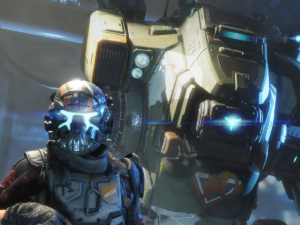
For the record, I’ll only be talking about the short, cinematic story mode here. Videogames are often labelled “cinematic” for various reasons, usually to do with strong visuals and camera-work. What I mean here is that this game actually felt (not just looked) like a movie. It’s relatively simple to connect this game to 80s and 90s staples like Top Gun–the macho pilots, radio chatter, and the one Titan adversary calling himself “Viper” make this one easy. It’s also rather Transformers-coded, with the benevolant robot-friend BT-7274 standing in for Optimus Prime, or perhaps Knight Rider’s K.I.T.T.
The plot leaned into this one-off action blockbuster sentiment. You’re a rifleman with aspirations to become one of the near-legendary pilots of the mech robots called Titans. So naturally, moments into your first mission alongside those pilots, the real pilot is killed and you have no choice but to establish the neural link to the massive robot death machine. (Well, not you, but Jack Cooper, obviously.)
The IMC are, as evil commercial-fascists are wont to, in the midst of harnessing a fabulously mysterious and powerful artefact from an ancient…(?) alien…(?) civilisation (???) … Nevermind. It’s clear that the miniature, trial-version Folding Arc Weapon is capable of destroying a moon, so the full-size version is definitely a threat to the Militia (Cooper et al.) homeworld of Harmony. And really, that’s all we need to know.
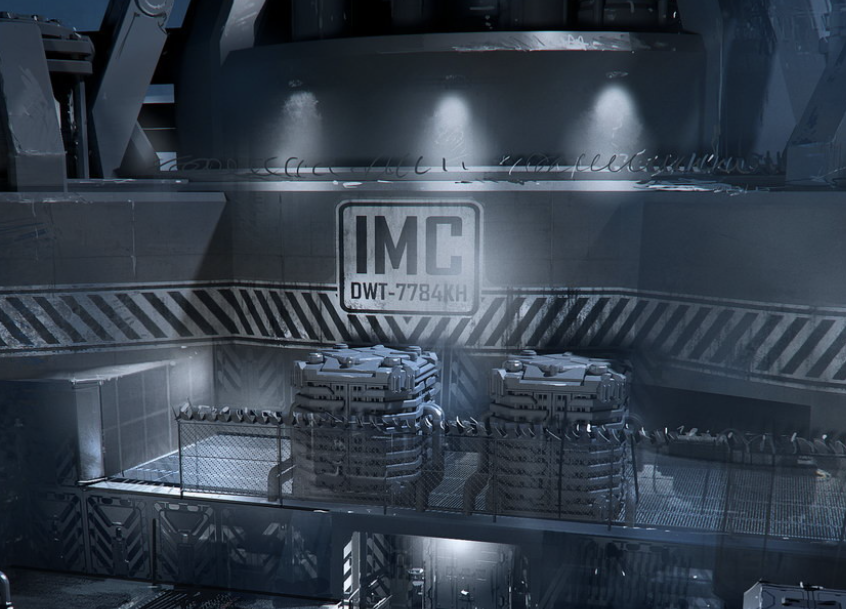
(Image: detail from concept artist Steve Burg)
Did I mention that the left shoulder button activated instantaneous time travel?
Titanfall 2 incorporates a handful of one-off mechanics that integrate into only one level each. In a sense, they are wildly inefficient uses of design and development time. In another sense, they contribute to the overall excellent pacing of the game. It never gets old, because something interesting changes in just about every level. The personal cloaking device was very useful more often than I care to admit. The time-travel mechanic was actually brilliant in highlighting some of the backstory without ever slowing down progress through the present-day level. The different Titan loadouts were fun to experiment with and so easy to swap between–no returning to base to plan out a new spec or spending resources. Just hit the D-pad to select.
The up-tempo pacing was essential to this little campaign, because at only a few hours, there really wasn’t much else to hold on to. The game keeps moving forward from beat to beat, a bit like Cooper double-jumping between platforms and walls (with the entire level occasionally rotating around like some infernal clockwork engine), never really pausing to catch its breath. Unlike Top Gun, for example, there is no Kelly McGillis to take Jack’s breath away, just more distant platforms for BT to pitch his pilot towards. And I can’t really fault TF2 for its simplicity. I didn’t get bogged down in interminable expository speeches, didn’t have to calculate any optimal skill tree depedencies, or sort out a pile of indecipherable currencies in order to progress. I got to play a videogame, finish it, and enjoyed myself throughout.